
For EHU, the conference provided an important international platform to raise awareness of the Belarusian authorities’ designation of the University as an “extremist organisation” and to draw attention to the challenges facing educational institutions committed to academic freedom and democratic values.
Addressing the international academic community, Dr. Vilius Šadauskas highlighted EHU’s unique mission and the significance of its work for students from Belarus and other post-soviet countries. EHU has developed an educational model specifically designed to make European higher education accessible to students who might otherwise face substantial financial, linguistic, social, or institutional barriers.
Dr. Šadauskas emphasised that EHU’s mission extends beyond providing academic qualifications. The University creates opportunities for students to become part of the wider European academic community, develop independent and critical thinking, and pursue educational and professional paths that might otherwise remain inaccessible.
Reflecting on the impact of EHU’s educational mission, the Rector shared a particularly meaningful observation: some of the University’s most successful students have been those who, when confronted with difficult circumstances, were able to transfer to other Lithuanian and European universities. While such decisions represent a bittersweet reality for EHU, they also demonstrate the effectiveness of its educational model. By equipping students with the knowledge, skills, and academic preparation necessary to continue their studies elsewhere in Europe, EHU fulfils one of its fundamental purposes: opening doors to European higher education.
A central focus of Dr. Šadauskas’s contribution was institutional resilience, adaptability, and responsibility towards students in the face of political pressure and uncertainty.
The designation of EHU as an “extremist organisation” by the Belarusian authorities has created additional challenges for the University and its community. Nevertheless, EHU remains committed to its educational mission and, above all, to the students who have chosen to continue their studies at the University, as well as those who continue to seek the opportunities it offers.
Dr. Šadauskas stressed that institutional resilience requires more than the ability to withstand external pressure. It demands agility, a willingness to adapt, and a sustained commitment to the people and values an institution exists to serve. For EHU, this means maintaining educational continuity, protecting opportunities for students, and ensuring that political challenges do not undermine the University’s long-term mission.
Concluding his address, EHU Rector Dr. Vilius Šadauskas reaffirmed the University’s determination to continue its work in Lithuania and remain an active member of the European higher education community:
“EHU was here, is here, and is determined to stay here for many years to come.”
The University’s participation in the Magna Charta Universitatum Anniversary Conference represents an important step in bringing EHU’s experience and the challenges it faces to the attention of the international academic community. It also reinforces the importance of international academic solidarity and the shared responsibility of universities to uphold academic freedom, institutional autonomy, and access to education.
As discussions on the future of higher education increasingly focus on the relationship between university independence and societal responsibility, EHU’s experience offers a concrete example of how an academic institution can remain committed to its mission despite extraordinary external pressures.
About the Conference
The Magna Charta Universitatum Anniversary Conference, “Beyond Resilience: Universities as Active Value-Driven Agents in a Changing World,” took place in Vilnius on 15–16 October 2026. Organised by Mykolas Romeris University in cooperation with the Magna Charta Observatory, the event brought together international academic leaders to explore the role of universities in strengthening democratic societies, safeguarding academic values, and responding to contemporary challenges.
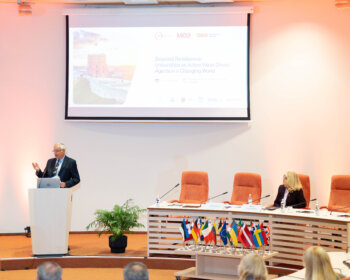

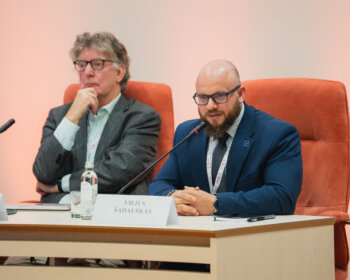
Photo credits:
Mykolas Romeris University website