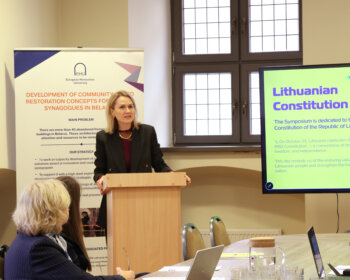
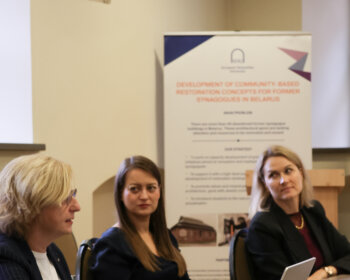
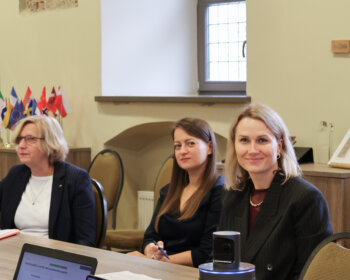
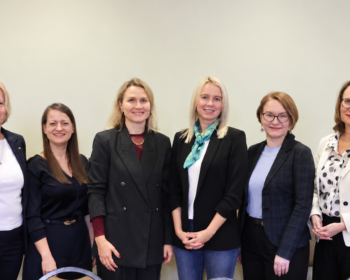
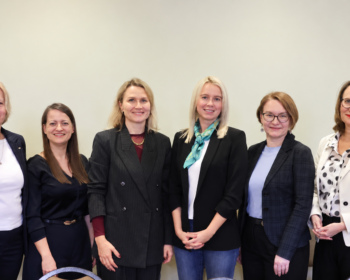
The symposium opened with a statement by Dr. Lina Gálvez, Chair of the Committee on Women’s Rights and Gender Equality of the European Parliament, who reviewed recent EU developments on gender-based and digital violence and called for stronger coordination in the face of growing attacks on equality. “The Directive on Combating Gender-Based Violence was a major milestone for European law, and the EU has built a strong legal defence against digital violence – a protection that is evolving fast to address new threats,” Dr. Lina Gálvez said.
Assoc. Prof. Dr. Ingrida Danėlė-Žalimienė, Head of the Academic Department of Social Sciences at EHU, turned to the Lithuanian Constitution. “Lithuania’s constitutional guarantee of women’s equality is real, though unwritten, partial, and selective. It is strongest where it reinforces traditional roles, and most cautious where it challenges them. It is a guarantee that has been built case by case and one that must be defended case by case,” Assoc. Prof. Dr. Ingrida Danėlė-Žalimienė said.
Prof. Dr. Martyna Łaszewska-Hellriegel of the University of Zielona Góra examined women’s voice and agency in the case law of the European Court of Human Rights. “The challenge today is to move beyond rights on paper and ensure that women’s voices are heard, their autonomy respected, and their rights effectively protected,” Prof. Dr. Martyna Łaszewska-Hellriegel said.
Other presentations looked at the gap between commitments and practice. Maryia Zharylouskaya, Lecturer at EHU and Head of the Legal Department of the Belarusian Congress of Democratic Trade Unions, addressed the ILO principle of equal pay for work of equal value: “More than a century after the ILO first recognised the principle of equal remuneration for work of equal value, its effective implementation remains a major challenge.” Dr. Manal Abed of Al-Quds University discussed women’s rights in Palestine: “Palestine has joined the core international human rights treaties, yet women’s rights remain largely on paper. Legal pluralism, legislative paralysis, occupation and weak remedies keep these commitments from reaching women’s lives.”
Scholars also focused on women’s lived experience. Dr. Zuzana Vasiliauskaitė of the Vytautas Magnus University and Vilnius University presented research on how intimate partner violence affects women’s civic engagement in Lithuania. “Encouraging women’s participation in public life starts with understanding their lives, more specifically how male violence affects both survivors and women who know a survivor,” Dr. Zuzana Vasiliauskaitė said. Assoc. Prof. Dr. Natalija Valavičienė, Head of the MA Gender Studies Programme at EHU, spoke about women’s migration decisions: “Women’s migration decisions are shaped by general structural conditions, including political, social, economic, and criminogenic circumstances, as well as by how women interpret and experience these conditions.”
Dr. Madison Winter Kurchik of Tallinn University of Technology and the Institute for the Future of Work in London examined the precarity of migrant care workers in global care chains. “Migratory patterns in global care chains function to produce a care drain, a process referred to as ‘emotional imperialism’ by Hochschild (2015),” Dr. Madison Winter Kurchik said.
The symposium offered a platform for interdisciplinary dialogue on the status of women today and strengthened EHU’s international academic partnerships in law and gender studies.