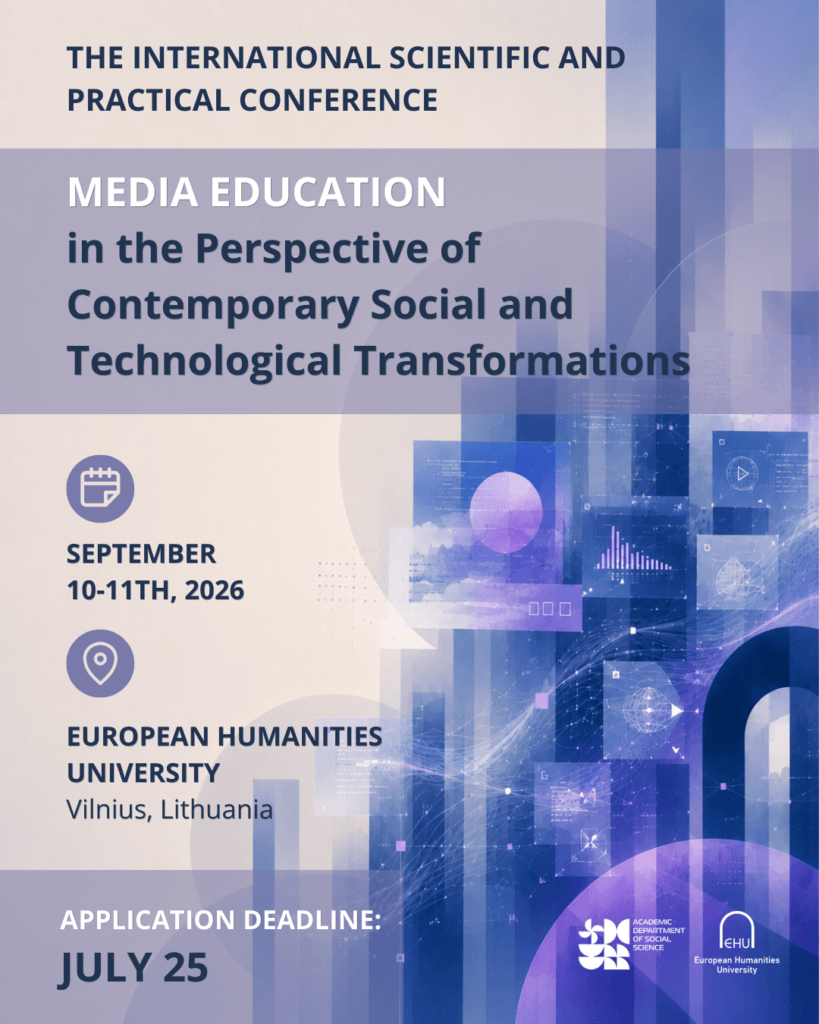
The last three decades were marked by the unprecedented transformation of the global media landscape, characterized by the swift development of new communication technologies, shift to digital media, changing of the channels and formats of communication, the growing role of social media platforms, and appearance of the new business models in regard to the production, distribution and consumption of media content. With the advent of AI the education environment, media sphere and labor market have (again) drastically changed. In addition to that, there are other significant, sometimes dramatic and perhaps even more important – either on a global, or regional scale – social, economic and political factors (such as wars, political repression, forced migration, formation of a diasporic media, growing economic inequality, precarity, gender and race discrimination and others) that also affect media industries and unavoidably impact university education.
With this conference, we aim to bring together academics and practitioners for discussing the challenges of training a new generation of media and communication professionals in the dynamically changing technological, economic, political and cultural environments. The conference is set to facilitate the dialogue between media scholars, educators and industry professionals on the evolving trends in education and communication fields; the impact of AI on the creation of media content, the changing patterns of media consumption; the prospects of the labor market for the graduates of Media and Communication Studies, and other relevant issues.
We welcome contributors from various scholarly fields and disciplines (Media and Communication, AI studies, Cinema and Audiovisual Media, Game Studies, Journalism, Sociology) who are engaged with the topics and questions addressed below:
- The future of media education in the rapidly evolving digital landscape: trends, challenges, and opportunities
- The value of Theory: revisiting classical approaches and developing new conceptual frameworks for Media Studies
- AI as a tool and subject of Media and Communication Studies
- Redesigning media curricula or changing teaching philosophies? Re-envisioning pedagogical approaches and teaching formats in the age of AI
- Universities and the Media: bridging the gap between academia and the industry needs
- Adapting curricula to the labour market transformations: entrepreneurship and innovation in media education
- Embedding diversity and inclusion in media education: why does it matter?
- The generation gaps and digital divide: how do these factors affect the learning environment in Media and Communication Studies?
- Media literacy for civic engagement: empowering informed participation in democratic and public life through teaching and research
- Doing Media Studies in the politically sensitive environments
- Media and data literacy across disciplines: integrating critical media skills into non-media curricula
Submission of abstracts:
To participate in the conference, please submit your proposal via online application form.
The application must include a title, an abstract (300-500 words) and short bio (max.150 words) with contact details of the applicant.
Conference languages:
English, Belarusian, Ukrainian, Russian.
Dates and deadlines:
The deadline for submissions: July 10th, 2026.
Authors of abstracts will be notified about selection by July 20th, 2026
Formats of participation: hybrid (offline, online).
Time framework – 20 minutes for each participant (presentation and discussion).
Please, inform the organizers about the format of your participation in advance – preferably, when you submit your proposal, but in any case, no later than one week before the conference.
Conference Venue: European Humanities University, 17 Savičiaus Street, Vilnius.