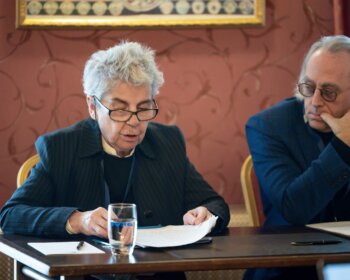
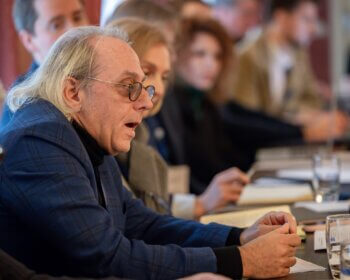
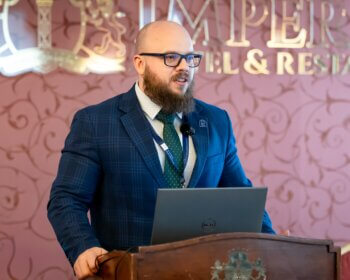
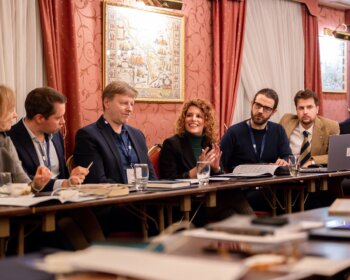
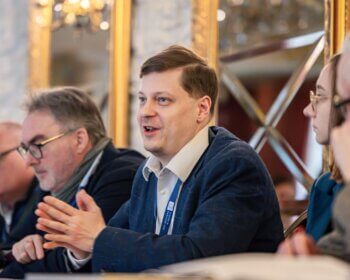
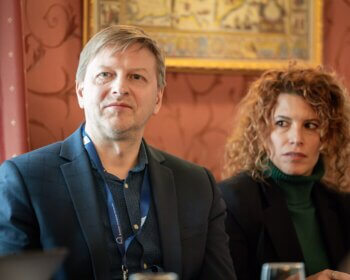
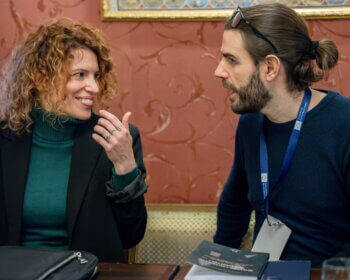
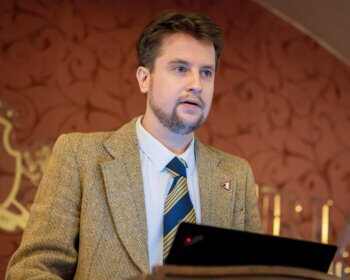
The conference convened leading Arendt scholars to ask what her thought can still offer to an increasingly divided and conflict-marked Europe. Opening talks, notably Roger Berkowitz’s “Joy in Times of Despair” and Chantal Delsol’s “Hannah Arendt and the Love of the World”, moved beyond purely diagnostic accounts of “dark times” by emphasizing positive, constructive resources (joy, love, hope, solidarity) that can sustain collective engagement and renew shared public life. The programme explicitly framed these themes within Arendt’s understanding of human plurality and common responsibility, setting the tone for discussions on how to move from analysis to imaginative and participatory practice.
Subsequent panels applied Arendtian categories to pressing contemporary questions. Ari-Elmeri Hyvönen examined emerging structural tendencies in today’s increasing use of, and reliance on, AI. Dalius Jonkus, together with Olivia Guaraldo, reflected on the idea of Europe and its current condition in a talk titled “The Testament of the Revolution. Reading Hannah Arendt in Kyiv”, addressing the growing distance between Western Europe and its eastern regions. Laurynas Peluritis initiated a discussion on the meaning of profound societal change in 21st-century Europe, while other speakers explored the legacy and interpretation of major historical turning points in Western intellectual history to highlight continuities and shifts in ideas and historical experience.
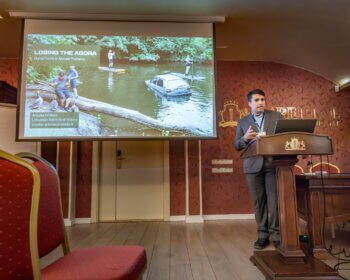
Sessions on the digital agora, including how Arendt’s thought can illuminate new modes of digital engagement and forms of shared visibility (Arvydas Grišinas), were held alongside discussions about different models of European integration (Daniele Bassi), as well as nuanced distinctions between public, private, intimate, and social life (Viktoras Bachmetjevas). Across panels, participants also reflected on differing Western interpretations of recent developments in Eastern Europe and the challenges these pose for mutual understanding and solidarity, suggesting that Arendt’s emphasis on natality, judgment, and action provides both critical insight and constructive resources for renewing common civic life. Finally, Anatoli Mikhailov delivered a talk on the role of intellectuals and universities in an era marked by contested interpretations of reality and debates about the authority of scientific knowledge.
This was an event organised by the EHU Academic Department of Humanities and Arts, Center for Humanities Education and EHU’s Hannah Arendt Initiative.